

Cause 05 · All year
Coal power plants
Direct answer: coal plants around Delhi release large amounts of SO₂ and NOx. In the air SO₂ turns into sulphate particles that can travel hundreds of kilometres. Most of these plants still do not have SO₂ scrubbers (FGD).
At a glance
- Coal units within 300 km of Delhi with public data were estimated to emit about 154 kilotonnes of SO₂ in 2025. 81% came from Category C plants, which no longer need FGD.72
- Under the July 2025 rules, only Category A plants must fit FGD, by December 2027. Category B plants need it only if an expert committee says so, and Category C plants are exempt.58
- Since 2025-26, coal plants must burn biomass pellets with their coal, at least 5%, and more in and around the NCR.71
- Our satellite analysis: 16 of 18 coal plants within 320 km of Delhi show an NO₂ plume.1
How coal plants pollute
Coal contains sulphur. When it burns, the sulphur becomes SO₂, and the heat also makes NOx. Tall chimneys carry these gases far from the plant, so people nearby may not see the smoke, but the gases turn into sulphate and nitrate particles over the whole plain (see cause 02). Flue-gas desulphurisation (FGD) units remove most of the SO₂ before it leaves the chimney.
What research says
- CREA (2026): of the 37 coal units within 300 km of Delhi, 25 had enough public data. Together they were estimated to emit about 154 kilotonnes of SO₂ in 2025, and Category C plants exempted from FGD gave 81% of it.72
- The rules: the July 2025 notification left FGD compulsory for only a small group of plants. One analysis says it cut the number of plants that must fit FGD to about one in five.58,84
- Enforcement: CAQM has served notices on six plants within 300 km of Delhi for missing their biomass co-firing targets.48
What the satellite shows
We compared satellite NO₂ and SO₂ within 7 km of each plant with a ring 25–50 km away. 16 of 18 plants within 320 km show more NO₂ than their surroundings, 13 of them by over 25%. SO₂ is noisier, but clear hotspots appear over the largest plants: Suratgarh, Talwandi Sabo, Rosa, the two Jhajjar plants and Harduaganj.1,3
Show the numbers
| Plant | NO₂ above surroundings |
|---|---|
| Suratgarh | +393% |
| Indira Gandhi STPP | +129% |
| Mahatma Gandhi TPP | +106% |
| Talwandi Sabo | +99% |
| Harduaganj | +92% |
| Panipat | +75% |
| NTPC Dadri | +48% |
| Plant | MW | km from Delhi | NO₂ above surroundings | SO₂ above surroundings (µmol/m²) |
|---|---|---|---|---|
| Indira Gandhi STPP, Jhajjar | 1,500 | 83 | +129% | +53 |
| Mahatma Gandhi TPP, Jhajjar | 1,320 | 85 | +106% | +41 |
| Talwandi Sabo Power | 1,980 | 241 | +99% | +108 |
| Harduaganj TPS, Aligarh | 1,265 | 112 | +92% | +52 |
| Panipat TPS | 710 | 93 | +75% | – |
| NTPC Dadri | 1,820 | 39 | +48% | – |
| Suratgarh STPS | 2,820 | 317 | +393% | +165 |
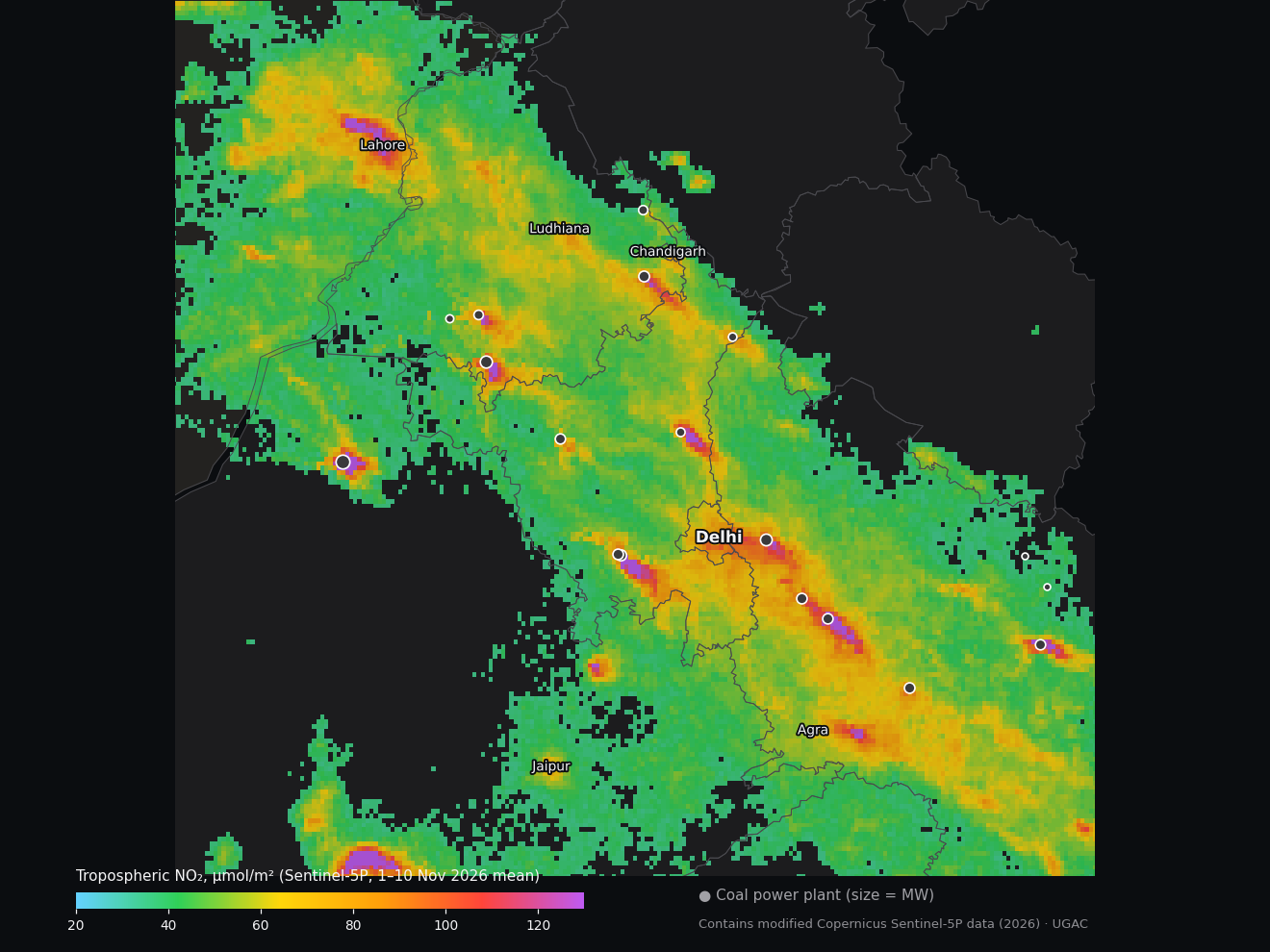
About 53 lakh people live within 10 km of these 18 plants. Panipat (6.3 lakh) and NTPC Dadri (5 lakh) have the most people nearby among plants within 100 km.1,15
What is being done
The main tool, FGD, has been made optional for most plants. Biomass co-firing has started but plants have missed targets.48,58 See Solutions for what we recommend.
Limits of this data
Panipat's NO₂ also includes a large refinery and city. SO₂ from TROPOMI is noisy; we smoothed it over ~17 km. These are 10-day averages from one satellite pass a day.