

Research report · People and health
Who breathes Delhi's air, and what it does to health
How polluted the air is, who lives closest to the sources, and what research says about health and money. Every claim links to its source.
Key findings
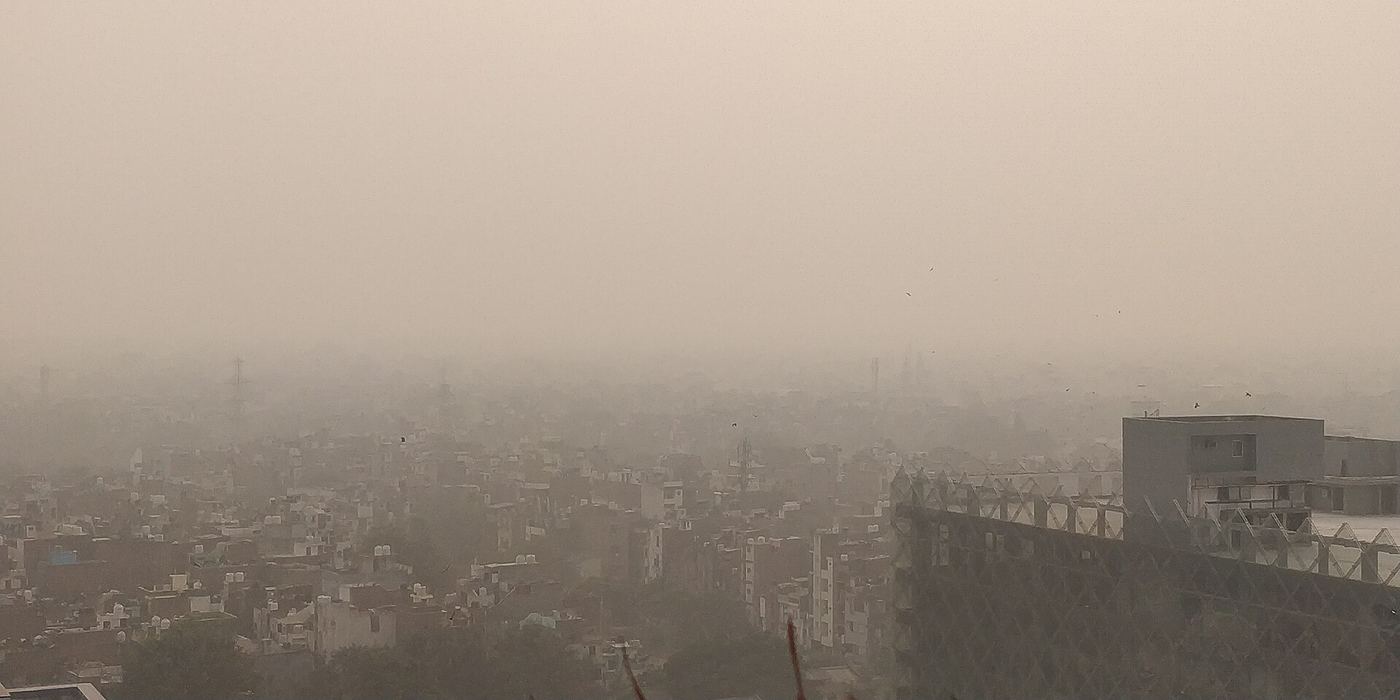
- Delhi's average PM2.5 in 2025 was 96 µg/m³, more than twice India's yearly limit of 40 and about 19 times the WHO guideline of 5.28,40,73
- An average Delhi resident loses about 8.2 years of life expectancy compared with air that meets the WHO guideline.21
- A study linked about 12,000 deaths a year in Delhi, 11.5% of all deaths, to short-term PM2.5 exposure.80
- In our study area of about 3.33 crore people, 1.14 crore live within 500 m of a major road and 24 lakh within 2 km of a landfill or dump.1
1. How polluted is Delhi's air?
India's national standard for PM2.5 is 40 µg/m³ as a yearly average and 60 µg/m³ over 24 hours. For PM10 it is 60 and 100.28 The World Health Organization's 2021 guideline is much stricter: 5 µg/m³ for the year and 15 µg/m³ over 24 hours.40
Show the numbers
| PM2.5 (µg/m³, yearly) | |
|---|---|
| Delhi 2025 | 96 |
| India standard | 40 |
| WHO guideline | 5 |
Using CPCB data, Delhi's 2025 average was 96 µg/m³, and every monitoring station in the city was above the national yearly standard.73 The Delhi Economic Survey, using DPCC data up to 9 December, gave 100 µg/m³ for PM2.5 and 209 µg/m³ for PM10, and called it the lowest since 2015 apart from the lockdown year 2020.69 So the air is improving slowly, but it is still far from safe.
2. Who lives closest to the sources?
We overlaid WorldPop 2020 population (1 km grid) on the source maps for the study area around Delhi (28.2–29.0°N, 76.8–77.65°E), home to about 3.33 crore people.1,11,15
Show the numbers
| Living near | People |
|---|---|
| Major road (500 m) | 1.14 crore |
| Industrial area (1 km) | 1.11 crore |
| Landfill or dump (2 km) | 24 lakh |
Population-weighted satellite NO₂ is 77.8 µmol/m², 13% above the area average of 68.8. In other words, people tend to live exactly where NO₂ is higher. About 2.1 crore people live where NO₂ is 75 µmol/m² or more.1,3,15
3. What this air does to health
Fine particles (PM2.5) are small enough to go deep into the lungs. WHO links exposure to fine particles with heart and lung disease, stroke and cancers, including lung cancer.16
- Life expectancy: the Air Quality Life Index estimates that Delhi residents lose 8.2 years of life compared with air meeting the WHO guideline, and 4.7 years compared with India's own standard of 40 µg/m³. It uses 2023 data.21
- Deaths: a 2024 study in Lancet Planetary Health, covering 10 Indian cities from 2008 to 2019, linked about 33,000 deaths a year to short-term PM2.5 exposure. Delhi had the highest share, about 11.5% of deaths, or about 12,000 a year.80
- Children: a study of more than 4,300 Delhi children aged 13 to 17, published in Lung India, found weak lung function in about one in three.50
- Who is most at risk: the Health Ministry names children, pregnant women, older people, people with existing illness, and workers exposed to pollution as especially at risk.24
4. What each AQI level means for your health
This is the official table issued by CPCB with its AQI bulletin, as given in the Health Ministry's 2025 advisory. "Vulnerable" means children, older people and people with lung or heart disease.24
| AQI | Possible health effects | Advice for everyone | Advice for vulnerable people |
|---|---|---|---|
| Good 0–50 | Low risk | No special precautions | No special precautions |
| Satisfactory 51–100 | Minor breathing discomfort in vulnerable people | No special precautions | Do less long or strenuous outdoor exertion |
| Moderate 101–200 | Breathing or other discomfort in vulnerable people | Do less long or strenuous outdoor exertion | Avoid long or strenuous outdoor exertion |
| Poor 201–300 | Breathing discomfort in healthy people on long exposure; discomfort in vulnerable people on short exposure | Avoid outdoor physical exertion | Avoid outdoor physical activities |
| Very Poor 301–400 | Respiratory illness in healthy people on long exposure; marked illness in vulnerable people on short exposure | Avoid outdoor activity, especially early morning and late evening | Stay indoors and keep activity low |
| Severe 401–500 | Respiratory illness in healthy people on long exposure; serious illness in vulnerable people on short exposure | Avoid outdoor physical activities | Stay indoors and keep activity low |
5. How to protect yourself
The Health Ministry's advisory recommends the following on poor to severe days (AQI above 200):24
- Avoid walks, runs and exercise outdoors in the early morning and late evening.
- Keep outer doors and windows shut in the morning and late evening; if you need to air the room, do it between 12 noon and 4 pm.
- If you use a mask, a close-fitting disposable N95 or N99 helps. Paper masks, handkerchiefs, scarves and cloth do not work.
- An air purifier may help; avoid purifiers that produce ozone.
- Do not burn wood, coal, dung or kerosene at home; use gas or electricity.
- Seek medical advice quickly if you feel breathless, cough a lot or have chest pain.
6. What it costs the economy
A 2019-based study by Dalberg estimated that air pollution costs Indian businesses about US$95 billion a year, roughly 3% of India's GDP. Delhi's loss has been put as high as about 6% of its GDP a year.67