

Cause 09 · Diwali and weddings
Firecrackers
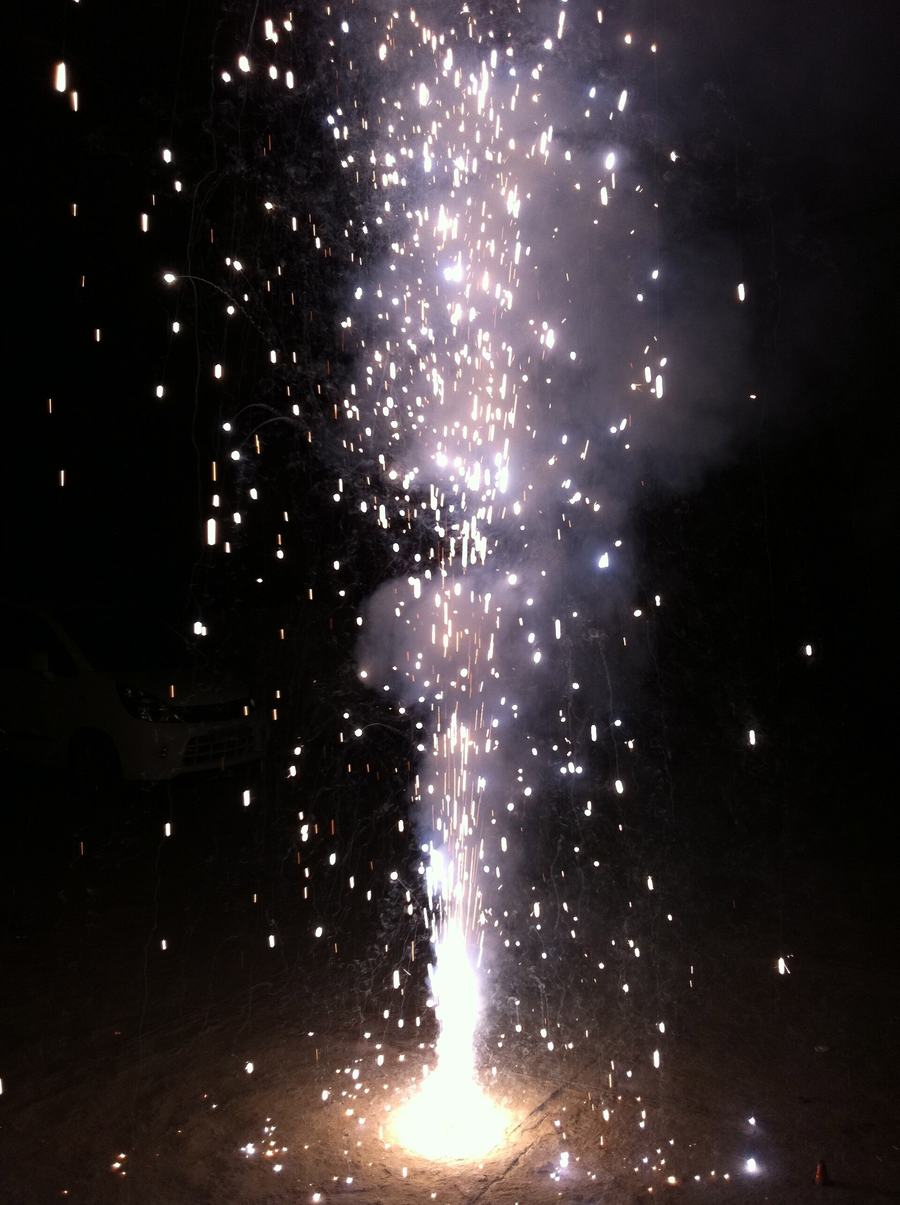
Direct answer: firecrackers cause a short but very sharp jump in pollution on Diwali night. On a still winter night the smoke has nowhere to go.
At a glance
- Delhi's 24-hour average AQI on Diwali 2026 (8 November) was 376, against 369 the day before.85 It was the worst Diwali day since 2021 (382).44,53
- The day after Diwali has had an AQI above 300 ("Very Poor" or worse) every year since 2016. The worst was 462 in 2021.44,53
- In 2025 the Supreme Court allowed certified green crackers in NCR, only at set hours on the day before Diwali and on Diwali.83
- Our monitor analysis: PM2.5 on Diwali night was higher than on ordinary nights earlier that week at most monitors.1,10
How firecrackers pollute
Firecrackers release fine particles made of metal salts, sulphur and carbon, along with SO₂ and NOx, all within a few hours. Diwali falls in October or November, when the air near the ground is still and shallow at night (see cause 10), so the smoke builds up over the city instead of spreading out. Crop-fire smoke is often present at the same time.
What the data says
Show the numbers
| Year | Diwali-day AQI |
|---|---|
| 2016 | 431 |
| 2017 | 319 |
| 2018 | 281 |
| 2019 | 337 |
| 2020 | 414 |
| 2021 | 382 |
| 2022 | 312 |
| 2023 | 218 |
| 2024 | 328 |
| 2025 | 345 |
| 2026 | 376 |
Diwali-day AQI has stayed in the "Poor" to "Severe" range in every year shown except 2023, when it was 218. The day after Diwali is usually worse than Diwali day itself, because the smoke from the night lingers into the morning.44,53
What the ground monitors show
Using hourly ground data from 63 monitors, we compared PM2.5 on Diwali night (8 Nov, 7 pm–3 am) with the same hours on ordinary nights earlier that week (4–6 Nov). PM2.5 was higher at 56 of 63 monitors. The largest rises were at Sector-1, Noida (+407%), New Industrial Town, Faridabad (+242%), Lodhi Road, New Delhi (+240%), Nehru Nagar, Delhi (+219%). Chhoti Diwali night (7 Nov) was also very polluted, as many people burst crackers on both nights. After allowing for weather in a regression (see cause 10), Diwali night came out about 70–104% above other hours, with a wide uncertainty range.
1,10The CAMS model shows Diwali night 14% lower than the night before, while monitors went up. The model's emission data does not include firecracker smoke, so ground monitors are the reliable way to measure this cause.9
What is being done
After a full ban in NCR earlier in 2025, the Supreme Court allowed sale of certified green crackers from 18 to 20 October 2025, with bursting limited to 6–7 am and 8–10 pm on the day before Diwali and on Diwali.83 See Solutions for what we recommend.
Limits of this data
AQI figures for past years come from CPCB data as reported in the news; different reports use slightly different averaging windows. Our Diwali comparison uses hourly PM2.5 from OpenAQ and does not remove the effect of weather or crop fires on its own.